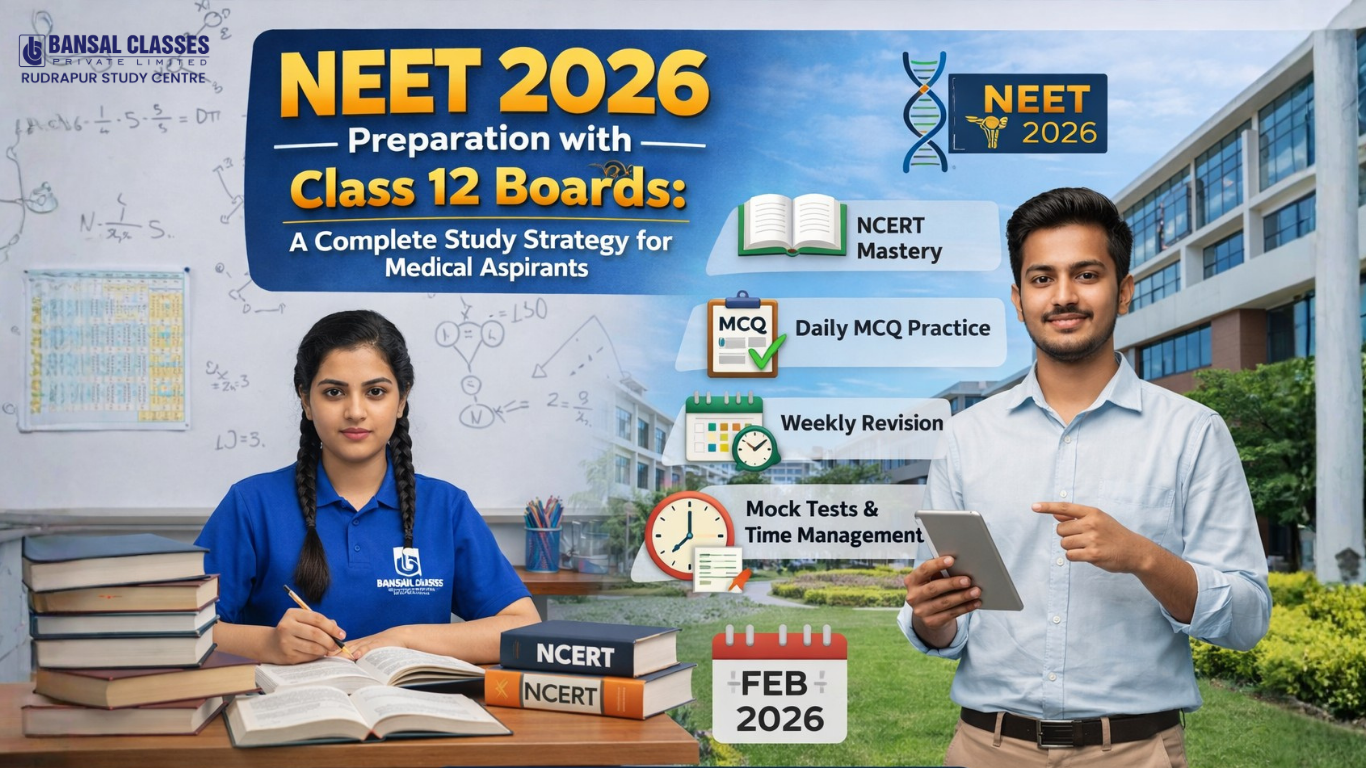
NEET 2026 Preparation with Class 12 Boards: A Complete Study Strategy for Medical Aspirants
Understanding the Relationship Between NEET and Class 12 Boards
One of the most significant advantages for NEET aspirants is the overlap in the syllabus. Physics, Chemistry, and Biology for NEET are entirely derived from Class 11 and Class 12 NCERT textbooks—the same books prescribed for board exams.
The key difference lies in assessment style:
- Board exams evaluate written explanations, diagrams, and stepwise problem-solving.
- NEET tests conceptual clarity through multiple-choice questions under time pressure.
When students build strong fundamentals for boards, NEET preparation becomes an extension of that learning rather than an additional burden.
Recognising this relationship early helps students streamline their efforts and avoid duplicating study work.
Develop a Unified Academic Mindset
The first step in successful NEET preparation, along with board exams, is changing how you think.
Do not treat NEET and boards as two separate battles. Instead, view them as two stages of the same journey.
Boards help you understand concepts deeply.
NEET trains you to apply those concepts quickly.
This unified mindset offers several benefits:
- Reduced mental stress
- Better time management
- Stronger memory retention
- Greater consistency throughout the year
Students who adopt this approach from the beginning maintain momentum and avoid last-minute panic.
Build a Realistic Daily Study Routine
A balanced study routine forms the backbone of dual preparation. Your schedule must include theory learning, MCQ practice, and revision—without exhausting yourself.
Sample Daily Study Framework
Morning (2–3 hours):
Board-focused theory using NCERT (reading, derivations, diagrams)
Afternoon (2 hours):
NEET MCQ practice from the same topics studied earlier
Evening (2 hours):
Weak areas, backlog chapters, or coaching homework
Night (1 hour):
Light revision of formulas, reactions, and Biology diagrams
This cycle ensures that concepts learned for boards are immediately reinforced through NEET-style questions.
Quality matters more than quantity. Six to eight focused hours daily are far more effective than irregular long sessions.
NCERT: Your Most Powerful Study Resource
NCERT textbooks are the foundation of both exams. Almost every NEET topper credits mastery of the NCERT material as the primary reason for their success.
Subject-Wise NCERT Strategy
Biology
- Read every line carefully
- Memorise diagrams, tables, and examples
- Learn definitions exactly as written
- Revise frequently
Nearly 90% of NEET Biology questions are directly or indirectly based on the NCERT.
Chemistry
- NCERT is crucial for Inorganic and Organic Chemistry
- Memorise reactions and mechanisms
- Pay attention to the boxed points and examples
Physics
- Focus on understanding concepts
- Practice NCERT numericals
- Learn formulas and derivations for boards
Before turning to reference books, revise the NCERT at least two to three times.
Prioritise High-Weightage Chapters Early
Specific chapters appear frequently in both NEET and board exams. Completing them early gives a confidence boost and creates a strong foundation.
High-Overlap Topics
Biology: Human Physiology, Genetics, Ecology, Biotechnology
Chemistry: Chemical Bonding, Biomolecules, Organic Basics, Electrochemistry
Physics: Mechanics, Current Electricity, Magnetism, Thermodynamics
Mastering these chapters improves mock test performance and motivates further study.
Convert Theory into Performance Through Daily Practice
Reading alone is not enough. Application is key.
Board exams require descriptive answers, while NEET demands speed and accuracy. To bridge this gap:
- Write board-style answers weekly
- Practice diagrams regularly
- Solve 60–100 MCQs daily
- Maintain an error notebook
Review mistakes every evening. Understanding why an answer went wrong is more important than getting it right.
This habit builds exam temperament and sharpens problem-solving skills.
Weekly Revision: The Secret to Long-Term Retention
Revision is often underestimated but is the most critical element of preparation.
Every week, revise:
- Topics studied during the week
- Incorrect MCQs
- Biology diagrams
- Chemistry reactions
- Physics formulas
A structured weekly revision cycle prevents forgetting and reduces pressure before exams.
Use short notes, flashcards, and formula sheets to make revision quick and effective.
Use Mock Tests as Learning Tools
Mock tests are not just for evaluation—they are learning opportunities.
Suggested Frequency
- NEET mock test: Once every 7–10 days
- Board sample papers: Once a week
After each test, analyse:
- Time management
- Weak chapters
- Accuracy rate
Spend more time reviewing mistakes than taking tests. This reflection leads to rapid improvement.
Make Coaching Support Work in Your Favour
Many students benefit from guided preparation and structured discipline.
Institutes like Bansal Classes Rudrapur follow integrated academic models that combine coverage of the board syllabus with NEET preparation schedules. Regular testing, performance tracking, and personalised feedback help students remain focused and consistent.
Such structured environments are beneficial for students who struggle with self-discipline or time management.
Maintain Physical and Mental Well-Being
Academic success depends heavily on physical health and mental clarity.
Students preparing for NEET alongside boards should:
- Sleep at least 7 hours daily
- Eat nutritious meals
- Take short breaks between study sessions
- Do light exercise or stretching
- Limit screen time and social media
Burnout reduces efficiency and motivation. A balanced lifestyle sustains long-term productivity.
Common Mistakes Students Must Avoid
Avoid these pitfalls:
- Treating boards and NEET separately
- Ignoring NCERT details
- Skipping revision cycles
- Overloading daily schedules
- Studying without MCQ practice
Correcting these habits early can dramatically improve outcomes.
Final Thoughts
Preparing for NEET along with Class 12 board exams is not about studying more—it’s about studying smarter.
An integrated strategy built on:
- NCERT mastery
- Daily MCQ practice
- Weekly revision
- Balanced scheduling
- Mental wellness
creates a powerful preparation system.
Students who follow this approach rarely feel overwhelmed. Instead, they gain confidence as board studies strengthen concepts and NEET practice sharpens application.
With discipline, consistency, and the proper guidance, excelling in both NEET 2026 and Class 12 boards is absolutely achievable.